Monkey Student: School Prank
- 4.4
- Rating
- 1.00M
- Installs
- Free
- Price

 Analysis by App-foxy
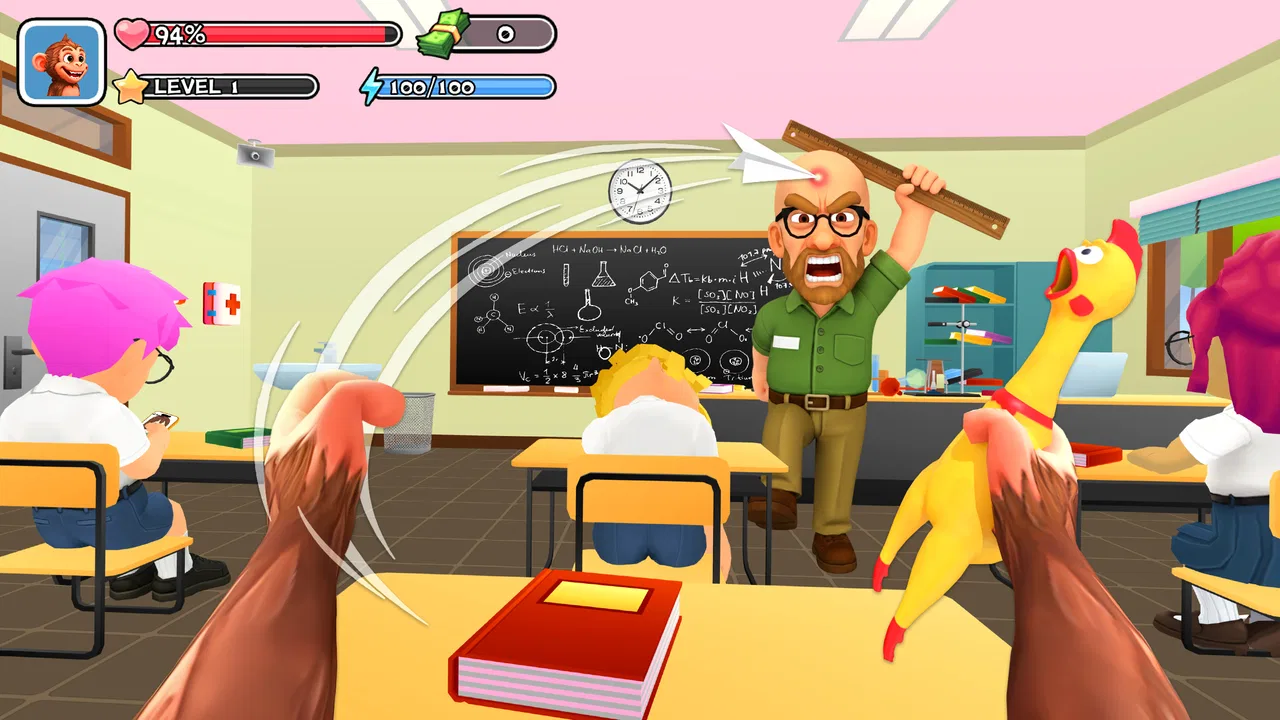
Monkey Student: School Prank is a free simulation game built around one clear idea: playing as a mischievous monkey student and turning an ordinary school setting into a playground for trouble. I approached it expecting a quick, silly distraction rather than a deep school-management simulator, and that expectation shaped my experience in a useful way. The appeal is not realism or careful planning in the traditional sense. It is the immediate satisfaction of causing playful disruption, then seeing how far I can push the situation before the joke loses its charm.
That focus makes the game easy to understand. I do not need to learn a complicated economy, manage a long list of characters, or study a detailed simulation before having fun. The central loop is about movement, interaction, and mischief. I can smash, throw, and interfere with the school environment, which gives the game a more active feel than a quiet management title. The result is best described as short-session school chaos: something I can open when I want a few minutes of humorous experimentation.
Why the prank-focused gameplay matters
The strongest capability here is the freedom to create trouble directly instead of simply watching a simulation unfold. In many school-themed games, the player is asked to attend classes, organize schedules, decorate rooms, or complete routine tasks. This one reverses that expectation. The school is not mainly a place to maintain; it is the stage for the player’s antics. That change in perspective gives every object and corridor a different purpose, because I am looking at the environment for opportunities rather than responsibilities.
You May Also Like

 Blood Strike: 2.5 Anniversary
Blood Strike’s Loadouts Turn Every Drop Into a Tactical Gamble
A close look at Blood Strike’s custom loadouts: how fast access to signature weapons reshapes its battle royale rhythm, rewards preparation, and narrows the gap between fights.

 Pandora - Music & Podcasts
Pandora’s Music Is Easy to Start, but Harder to Recover
Pandora’s strength is its low-effort path from a seed to a station. Its weak spot is how much confidence it asks you to place in connection, setup, and quiet recovery.

 8 Ball Pool
 Is Built on Rivalries, Rematches, and Routine
A close look at the rivalries, rematches, shared routines, and unanswered safety questions that turn a quick pool match into a persistent mobile community.

 Samsung Music
’s Quiet Strength Is Playing What You Already Own
Its reach comes less from spectacle than from dependable access to a personal library. That simplicity is both the app’s strongest retention engine and its ceiling.

 AccuWeather: Weather Radar
AccuWeather Review: A Quick, Clear Forecast for Everyday Decisions
For everyday plans, the best forecast is the one you can understand quickly. AccuWeather makes rain timing, radar, and local conditions easy to act on, with a few trade-offs.

 Hill Climb Racing
Why Hill Climb Racing Still Turns Crashes Into One More Run
A tiny car, a bumpy hill and one more upgrade: Hill Climb Racing keeps resurfacing because its simple chaos makes every near-miss feel personal.
More From Our News Desk



In practice, the smashing and throwing mechanics make the game feel more physical than a typical life simulator. Even when the objective is simple, interacting with the surroundings gives me a reason to keep testing the boundaries. I found myself asking what could be disturbed, which action would create the funniest result, and whether a different approach would make the scene feel more chaotic. That kind of curiosity is the main source of replay value.
The important distinction is that the game’s entertainment comes from experimentation, not from a large amount of narrative. If I want a carefully written school story with layered relationships, this is not the right choice. If I want a playful sandbox where the joke is that the student behaves badly, the concept is much more effective. The developer, Unicorn Studio Official, keeps the premise direct, which helps the game become approachable almost immediately.
I also think the monkey character is more than a visual gimmick. It gives the mischief a cartoon-like distance from real school behavior. The same prank would feel more uncomfortable in a serious school drama, but the exaggerated animal protagonist signals that I should treat the setting as slapstick fantasy. That tone is important because it tells me how to interpret the destruction and disruption: not as a realistic lesson about discipline, but as a deliberately ridiculous playground for harmless-looking chaos.
How the main loop feels during a normal session
My usual approach is to begin by moving through the school and looking for an interaction that immediately produces a reaction. Once I find something worth testing, I try a second action nearby instead of rushing through the area. This makes the experience feel less like following a fixed checklist and more like improvising a small scene. The fun comes from building one prank on top of another, even when the game does not demand that I do so.
A useful tip is to slow down after the first successful interaction. The first smash or throw is easy to notice, but the better moments often come from considering positioning and timing. I get more from the game when I treat each room as a compact puzzle of possibilities rather than tapping every obvious object as quickly as possible. This is a non-obvious strength: the game rewards a curious player’s attention, even though it presents itself as a simple comedy experience.
Another practical habit is to vary the order of actions. Repeating one favorite prank can be amusing at first, but it also exposes the limits of a focused game quickly. Switching between movement, throwing, and destruction helps the session stay fresh because I am changing the rhythm rather than merely repeating the same input. I would not call this a complex strategy system, but it is a better way to use the available interaction than treating the game as a single-button joke.
The game is also suited to playing without a long uninterrupted block of time. I can imagine using it during a short break, when I want something more active than scrolling but do not want to commit to a campaign. There is no need to prepare mentally for a serious simulation. I can jump into the school, create a little disorder, and stop when the novelty of that particular session fades.
The best everyday scenario for playing
The ideal situation is a quick evening break after work or study. I might have ten minutes before doing something else and want a game that gives me an immediate sense of control. Instead of spending that time learning a complicated system, I can enter the school, choose a direction, and start experimenting. The monkey’s role makes the session feel light, while the physical interactions provide enough activity to prevent it from becoming a passive experience.
It can also work as a casual game to show a friend who enjoys silly simulation concepts. The premise is understandable without a long explanation: a student monkey is there to cause trouble. That makes it easy to hand over the phone and let someone discover the joke through play. I would be more cautious about recommending it to someone who expects a polished competitive challenge, because the appeal depends heavily on enjoying the theme and the freedom to fool around.
For younger players, the Teen content rating is worth considering before installing. The cartoon presentation may make the premise feel mild, but parents should still decide whether school-based destruction and prank behavior fit the player’s age and expectations. I would not present it as an educational school game. Its value is entertainment, and its humor depends on breaking the normal rules of a school environment.
Where it differs from familiar simulation games
Compared with school-management simulations, this game removes much of the administrative pressure. I am not primarily balancing resources, planning lessons, or improving a campus over time. That makes it faster and more accessible, but also less satisfying for players who enjoy long-term progression and detailed decision-making. The trade is clear: I receive immediate interaction instead of a layered management challenge.
Compared with open-world sandbox games, the school setting gives the chaos a tighter identity. I am not wandering through a huge landscape with many unrelated activities. The smaller concept keeps the joke focused, but it can also make the experience feel narrower once I have tested the interactions that interest me most. Players who need a large map, extensive customization, or a long storyline will probably find a broader sandbox more rewarding.
It also differs from stealth-prank games that emphasize careful planning and avoiding detection. Here, the pleasure is more direct. I am encouraged to think about what I can disrupt, not to spend most of the session hiding and restarting after a mistake. That makes it friendlier for casual play, although it may disappoint anyone looking for tense pursuit mechanics or a demanding sequence of objectives.
This comparison explains who should skip it. If my favorite simulations are about building a sustainable system, optimizing numbers, or watching a community develop, this game is likely too immediate. If I prefer games where every action contributes to a substantial story, the prank premise may feel thin. I would choose a management or narrative alternative in those cases. The game is strongest when I want a focused burst of comic interaction rather than a complete virtual school life.
The tradeoffs behind the simple design
The same simplicity that makes the game approachable can reduce its staying power. A prank-centered loop is easy to enjoy but also easy to understand. Once I know the basic rhythm of moving, smashing, throwing, and causing disruption, I need personal curiosity to keep exploring. That is not necessarily a flaw, but it means the game depends more on the player’s mood than on a deep progression structure.
I also noticed a difference between a funny first experiment and a satisfying long session. The first few interactions benefit from surprise. Later, I need to create my own goals, such as trying a different route through the school or combining actions in a more deliberate sequence. Without that self-imposed variety, the experience can become repetitive. My advice is to play it in short bursts rather than expecting it to replace a larger simulation game.
The free entry point is convenient, especially for anyone who wants to test the concept before committing. At the same time, in-app purchases range from $0.99 to $99.99 per item, so I would approach the purchase side carefully. The broad range means I would not assume that every optional item is equally worthwhile. I would first decide whether the core prank loop already gives me enough enjoyment, then consider spending only if an addition clearly improves the way I play.
That is especially important for families. A free download can still lead to purchase decisions, so I would check the device’s purchase controls before handing the game to a child. This is not a criticism of the central idea; it is simply a sensible step whenever a free mobile game includes optional items. The game works best when I remain in control of how much I spend and do not confuse a larger purchase with deeper gameplay.
Performance expectations should also remain realistic. The game is designed around a compact, playful premise rather than the ambitions of a large console-style simulation. I would install it on a compatible device running Android 7.0 or later, then judge it by the quality of its short interactions rather than expecting a huge world. The current version is 1.0.7, which makes it sensible to keep the app updated through the normal store process when updates are available.
Who will get the most from this game
I think the best audience is someone who enjoys cartoon mischief, quick experiments, and simulation games that do not take themselves seriously. The game is particularly suitable for players who like discovering what an environment allows them to do. Instead of asking whether I can complete a complex objective, it asks me to enjoy the consequences of acting like the least responsible student in the building.
It is also a good fit for people who prefer active interactions over menus. The ability to smash and throw gives the session a tactile quality, and the school setting provides an easy-to-understand theme. I do not need to be deeply familiar with simulation games to appreciate the premise. The game communicates its personality through the character and the actions, which is one reason I could start playing without a long learning period.
Players who enjoy sharing funny moments may find extra value in it. A prank game naturally creates situations that are easy to describe or demonstrate, even if the overall system is not especially complex. I would use it as a light social recommendation rather than a serious multiplayer substitute: something to pass around, compare reactions to, or revisit when I want a quick laugh.
The audience is narrower for players who want sustained progression. I would skip it if I were searching for a detailed school simulator, a strategy game with difficult optimization, or a story-driven adventure. The game’s identity is built around immediate chaos, and choosing it means accepting that the joke matters more than a large collection of systems. That clarity is better than pretending it offers a different kind of experience.
What the store numbers suggest about its appeal
The game has reached over one million installs and holds a 4.4 average from around 3,100 ratings, with 46 written reviews shown alongside it. Those figures suggest that the simple monkey-student premise has found a substantial casual audience, while the written feedback can help prospective players understand whether the prank-focused style matches their taste. I would read the rating as a sign of broad accessibility, not as proof that every player will find the loop deep.
Its release date is November 28, 2025, so I would view it as a relatively new entry rather than a long-established simulation with years of accumulated content. That makes the current experience more important than assumptions based on other school games. The developer is Unicorn Studio Official, and the listed category is simulation, although the actual play style leans toward comic sandbox interaction rather than traditional management.
Because it is free, the easiest decision is to try it with a clear expectation: give the core prank loop a short, focused test. Do not begin by asking whether it can replace a full simulation game. Ask whether moving through the school and creating disruption remains amusing after the first surprise. That test will tell me more than the premise alone, especially if I am unsure how much repetition I tolerate.
My recommendation after spending time with it
I recommend Monkey Student: School Prank to players who want a lightweight, mischievous simulation with immediate physical interactions. Its best quality is the way it turns a familiar school setting into a space for experimentation. The monkey character, the throwing, and the smashing all support the same purpose, so the game feels focused rather than confused about what it wants to be.
I would not recommend it as a replacement for a deep management simulator or a story-heavy school adventure. Its limited concept can become repetitive if I play for too long, and the optional purchase range means I would keep spending under control. Still, those limitations are easier to accept when I treat it as a short-session comedy game instead of demanding a large progression system from it.
My practical recommendation is to play slowly at first, test different interactions, and create small personal challenges instead of repeating the first successful prank. That approach brings out the game’s most interesting quality: the school becomes a place to investigate, not merely a backdrop for tapping one action. For the right player, that is enough to make a free download worth trying. If playful chaos is more important to you than long-term complexity, this is a surprisingly direct way to spend a few spare minutes.
FAQs for Monkey Student: School Prank
01What is the main objective of Monkey Student: School Prank?
Monkey Student: School Prank is a fun and engaging game where players take on the role of a mischievous monkey navigating through school settings. The main objective is to complete various prank-related challenges without getting caught by teachers or other school staff, adding a layer of strategy and stealth to the gameplay.
02Is Monkey Student: School Prank suitable for children?
The game is designed with a playful theme that appeals to a younger audience. However, parents should be aware of the content, as it involves pranking scenarios. It’s advisable to review the game’s age rating and features to ensure it aligns with individual family values and guidelines.
03How does the game ensure a balance between fun and educational value?
While primarily focused on entertainment, Monkey Student: School Prank incorporates problem-solving elements that encourage critical thinking. Each level requires players to devise creative strategies to pull off pranks successfully, promoting cognitive skills while maintaining a fun atmosphere.
04Are there in-app purchases in Monkey Student: School Prank?
Yes, the game offers in-app purchases. Players can buy additional items, costumes, or power-ups that enhance gameplay. It’s essential for parents to be aware of these purchases, especially if the game is played by children, to manage spending and ensure a safe gaming experience.
05Can Monkey Student: School Prank be played offline?
Monkey Student: School Prank can be enjoyed offline, allowing players to engage in gameplay without an internet connection. This feature makes it a convenient option for on-the-go entertainment, though some features like leaderboard rankings may require an online connection to update.
Pros
- Engaging gameplay with creative pranks.
- Colorful graphics appeal to younger users.
- Simple controls make it easy to play.
- Regular updates with new levels.
- Encourages problem-solving skills.
Cons
- Ads can be intrusive and frequent.
- Limited levels may reduce replay value.
- In-app purchases can be pricey.
- Requires internet for some features.
- May not suit all age groups.

Monkey Student: School Prank
Gallery